 Ek Dum Desi – Your Desi Fitness Tips Buddy Find all desi tried and tested by millions fitness tips here.
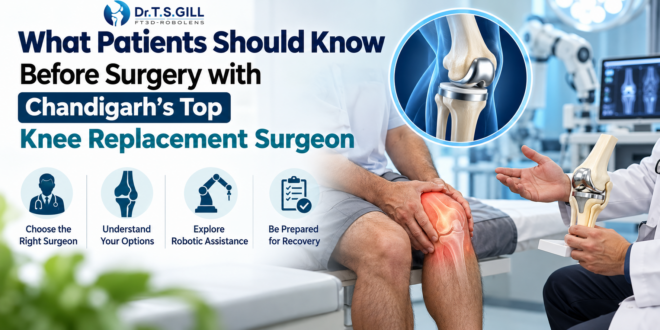
Your manner of life may progressively change due to knee pain. It may get harder to get out of a chair, walk to the neighborhood market, climb stairs, or take a morning stroll. You may start thinking about knee replacement surgery if medicine, physical therapy, and other therapies are no longer enough to relieve your pain.
It’s crucial to go beyond internet reviews or the newest surgical technologies while looking for the best knee replacement surgeon Chandigarh. The appropriate specialist should be aware of your problem, provide you with a clear explanation of your treatment options, and assist you in making an informed choice based on your particular requirements.
This article describes modern techniques, what to look for in a knee replacement surgeon, when surgery could be appropriate, and how to get ready for recovery.
When Is Surgery for a Knee Replacement Advised?
In a knee replacement, deteriorated joint surfaces are surgically replaced with prosthetic parts. Although certain other disorders can potentially harm the knee joint, it is frequently taken into consideration for those with severe osteoarthritis.
An orthopedic evaluation could be helpful if you suffer from:
- persistent knee pain that makes daily tasks difficult.
- rigidity or limited mobility.
- difficulty standing for long periods of time, walking, or climbing stairs.
- pain that prevents you from sleeping or restricts your freedom.
- symptoms that, despite proper non-surgical treatment, have not sufficiently improved.
- Although an X-ray can be useful in evaluating joint injury, imaging should not be the only factor considered when deciding whether to have surgery. Your overall health, exercise level, physical examination, symptoms, and treatment objectives are all important.
Not all patients with knee discomfort in Chandigarh require knee replacement surgery. Physiotherapy, activity modification, medication, or other appropriate treatments may offer relief without surgery, depending on the reason and severity.
1. Verify the credentials and experience of the surgeon
A crucial initial step is selecting a licensed orthopedic specialist with relevant knee replacement experience.
Examine the surgeon’s expertise, education, experience treating problems comparable to yours, and professional background. If primary knee replacement, partial replacement, and revision surgery are relevant to your condition, you can also inquire about experience with these treatments.
During your consultation, think about asking the following questions:
- What’s hurting my knees?
- How often do you carry out the suggested procedure?
- Are there viable alternatives to surgery?
- What dangers should I be aware of before making a choice?
- What kind of follow-up care and rehabilitation will I require?
- The official website of Dr. Tarandeep Singh Gill lists an MCh in Orthopedics from the University of Seychelles and an MS in Orthopedics from Bharati Vidyapeeth University. Additionally, his profile details fellowship training in sports medicine and arthroscopy at ARCUS Sportklinik in Germany, as well as training in reconstructive surgery and arthroplasty at St. Josef Hospital in Germany.
He claims to specialize in advanced joint surgery, revision knee replacement, and total and partial knee replacement. These data are available on the official About Dr. TS Gill page.
Experience is a crucial factor, but it should be weighed against clinical judgment, communication, treatment planning, and the needs of each patient.
2. Recognize Your Potential Knee Replacement Type
The procedure needed for every injured knee is different. Before suggesting a course of action, your surgeon will take into account the location and degree of joint damage, ligament function, symptoms, and other clinical findings.
Complete replacement of the knee
Replacing the damaged joint surfaces throughout the knee’s main compartments is known as total knee replacement. When several joint locations have been severely impacted by arthritis and other suitable treatments have not yielded sufficient alleviation, it may be taken into consideration.
partial replacement of the knee
Only the damaged joint compartment is replaced in a partial knee replacement. For certain patients whose arthritis is restricted to one place and whose remaining joint structures satisfy the requirements, it might be appropriate.
Revision knee replacement
Replacing or rebuilding parts from a previous knee replacement is known as revision surgery. For some issues, such as implant loosening, infection, instability, or severe wear, it might be necessary.
The indications, dangers, and rehabilitation needs of these surgeries vary. Instead of assuming that a more involved procedure is always preferable, ask your surgeon why a specific choice is suitable for your knee.
3. Inquire About Knee Replacement with Robotic Assistance
One of the technologies available for some knee replacement surgeries is robotic-assisted surgery. Using data from the patient’s anatomy, it can aid in surgical planning and assist the surgeon in carrying out a planned procedure.
The robot does not, however, choose or carry out the complete task on its own. Clinical judgments and surgical care are still the surgeon’s responsibility.
When talking about a robotic knee replacement, inquire:
- Does my condition qualify for robotic assistance?
- In my situation, how does it affect surgery planning?
- What are its possible benefits and drawbacks?
- Are traditional surgical methods appropriate as well?
- What extra expenses, if any, should I anticipate?
RoboLens FT3D knee resurfacing and robotic-assisted joint replacement are two of the treatments that Dr. TS Gill offers, according to his official website. To ascertain whether these methods are appropriate for a particular patient, the treating physician should be consulted.
Good surgical treatment involves more than just technology. Regardless of the method employed, accurate diagnosis, suitable patient selection, surgical skill, and rehabilitation are still crucial.
4. Select a Surgeon Who Describes Dangers and Options
For carefully chosen patients, knee replacement surgery chandigarh can enhance function and lessen discomfort, but it is a big procedure that cannot ensure a specific result.
Infection, blood clots, hemorrhage, stiffness, chronic pain, damage to nerves or blood vessels, and issues with the implant are all possible side effects. Your health, medical history, and the planned surgery are some of the variables that affect your individual risk.
Before making a choice, talk about:
- the anticipated advantages and practical constraints.
- your personal surgical risks.
- if more medical evaluation is required.
- the effects of postponing surgery.
- alternatives to surgery and the potential for a second opinion.
An ethical orthopedic surgeon should let you participate in the decision-making process and provide transparent answers to your inquiries. You should be aware of the treatment plan’s components and the reasons why surgery is being considered.
5. Recognize the Care Team and Hospital
The surgeon is not the only person involved in a knee replacement. The treatment process is influenced by the hospital setting, the anesthesia team, nursing care, infection control procedures, and rehabilitation assistance.
Inquire about the location of the procedure as well as the options for preoperative evaluation, pain control, early mobility, physical therapy, and follow-up.
Think about the practicalities of going to appointments and coming back for rehabilitation if you reside in Chandigarh, Mohali, or Panchkula. Before you travel, confirm the hospital’s current location and make an appointment directly with the clinic.
Additionally, you should know who to call in the event that you have unanticipated post-operative symptoms.
6. Get Ready for Recuperation Prior to Your Procedure
Preparation is the first step toward recovery. In order to prepare for surgery, your surgeon may suggest medical evaluations, modifications to certain drugs, suitable workouts, or other measures. Instead of making changes on your own, heed your doctor’s advise.
Rehabilitation following a knee replacement often focuses on progressively enhancing everyday function, muscle strength, movement, and balance. Exercises recommended by your professional staff, walking exercises, and physiotherapy may all be part of your approach.
Everybody recovers differently. Progress can be influenced by a number of factors, including general health, muscle strength, the type of treatment, complications, and adherence to therapy.
Prior to surgery, make plans for practical needs such access to prescribed medication, transportation to appointments, safe movement around your home, and assistance at home. Find out from your care team when you can start doing things like driving, working, and exercising again.
FAQs
1. How can I pick Chandigarh’s top knee replacement surgeon?
Seek out adequate hospital facilities, good communication, experience with your disease, relevant qualifications, and organized follow-up treatment. Select a surgeon who will explain the possible advantages, hazards, and alternatives.
2. When should I think about getting a knee replacement?
When significant joint injury results in ongoing discomfort and functional restrictions even after receiving the proper non-surgical treatment, it may be taken into consideration. An orthopedic specialist can determine if surgery is appropriate for your situation.
3. Is robotic knee replacement superior to traditional surgery?
Although its applicability and potential advantages vary, robotic aid can support surgical planning and precision. Inquire with your surgeon about the evidence, constraints, and options pertinent to your particular situation.
4. How long does it take to recover from a knee replacement?
Over the course of weeks and months, recovery happens gradually. Your health, the treatment, your recovery, and any issues will determine how long it takes. Guidance specific to your circumstances can be given by your treatment team.
5. Can elderly people replace their knees?
Eligibility is not determined solely by age. For older persons, overall health, functional limits, surgical risks, and personal treatment objectives are crucial factors to take into account.
6. Is it possible to manage knee discomfort without surgery?
Yes. Physiotherapy, exercise, activity adjustment, weight control where necessary, and medication prescribed by a clinician may all be part of the treatment, depending on the diagnosis. When the anticipated advantages outweigh the dangers, surgery is taken into consideration.
7. What should I pack for my initial consultation?
Bring a list of current medications, medical records, past X-rays or other imaging, information on past treatments, and inquiries regarding symptoms, available therapies.
NAP Details: Dr. Tarandeep Singh Gill
Doctor: Dr. T. S. Gill
Address: MAX SUPER SPECIALITY HOSPITAL
3RD FLOOR, NEW BLOCK B
PHASE 6, (SECTOR 56)
MOHALI, CHANDIGARH TRICITY
PUNJAB, INDIA
Phone: +91-82880 15106
+91- 62395 89197
Website: https://tsgillortho.com/
Instagram : https://www.instagram.com/drtarandeepsingh
Linkedin: https://www.linkedin.com/in/dr-tarandeep-singh-gill-b88746429/