 Ek Dum Desi – Your Desi Fitness Tips Buddy Find all desi tried and tested by millions fitness tips here.
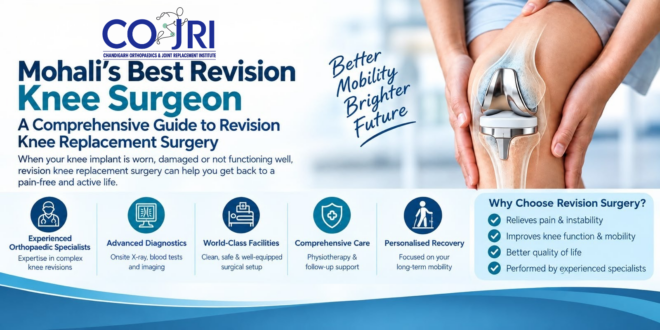
Replacing a knee joint may be the only treatment option for an individual suffering from severe arthritis or joint damage to improve mobility and Quality of Life. Overtime, the artificial joint may become worn or damaged and may no longer function as intended. Complications may arise surrounding the artificial joint that may also warrant further treatment. This may require a revision knee replacement surgery.
Finding the best revision knee surgeon Mohali is crucial for an individual suffering from stiffness, pain, instability and other complications following a prior knee replacement. It is important to understand the various causes of a revision surgery and the treatment and recovery options available to make informed decisions regarding your knee health.
What is Revision Knee Replacement Surgery?
Revision knee replacement surgery is used to remove or replace the components of a knee implant that is not functioning as intended. Unlike a primary knee replacement, a revision knee replacement requires more complex surgical skills as the surgeon must evaluate the previous implant, the surrounding bones, and the soft tissues of the knee.
The treatment plan is individualized to the patient and depends on the underlying cause, the condition of the previous implant, and the patient’s health and other medical conditions.
In your search for a revision knee surgery specialist Chandigarh, it is recommended that you find an experienced orthopaedic surgeon to review your case and previous surgeries and determine the best course of treatment.
How do I find the best Revision Knee Surgeon in Mohali?
Identifying the right specialist is more involved than just identifying the closest hospital. Revision procedures are best performed by specialists who are familiar with the complexities of knee revision surgery.
Consider the following factors when evaluating a knee replacement specialist:
- Do they have a specialized knee revision surgery program?
- Are there onsite diagnostic services? (x-ray, blood tests, other imaging)
To explain treatment planning, an orthopaedic surgeon will discuss the issues with the patient’s current knee implant, potential treatment options, the risks associated with each option and the expected outcomes of the possible treatments.
When analyzing a hospital’s facilities, determine if the hospital is equipped to provide:
- adequately clean and well-maintained surgical facilities
- adequate management of infection(s)
- anesthetic services (that meet the American Society of Anesthesiologists standards and are appropriate for the planned procedure)
- an adequate rehabilitation program
As part of a coordinated team approach, physiotherapy and follow-up care are essential to the rehabilitation process after total knee replacement surgery.
When comparing surgeons, it is important to evaluate communication, qualifications and relevant surgical experience, and whether the available resources are sufficient and appropriate.
Recovery from revision knee replacement surgery is longer and more complex than from a primary knee replacement surgery.
A standard post surgery care plan is expected to include:
- -Pain management: It is essential to strictly follow the medication and wound care instructions given by the treating team.
- -Early Mobilization: It is important to follow the instructions of the treating team regarding supported movement and walking.
- -Physiotherapy: It is very important to regularly perform the exercises given by the treating team.
- -Activity Modification: Gradually resuming usual activities is determined and directed by the treating team.
- -Regular Follow up: This helps to assess healing and stability of the implant.
Patients are advised to inform their treating team as soon as possible if they experience any of the following: sudden increase in body temperature, increasing swelling, redness or discharge at the wound site, pain that is not relieved by medications, increase in knee swelling, shortness of breath, or chest pain.
Revision knee surgery may be recommended to relieve knee pain and increase knee function. However, there are increased risks associated with knee revision surgery including pain, stiffness, fracture, blood clots, and more.
Prior to making a decision regarding a revision surgery, it is recommended to get a consultation with a specialist to fully understand the risks and benefits associated with the procedure based on individual situation.
Patients in and around Chandigarh and Mohali can approach us for an expert opinion in the case of persistent symptoms after knee replacement. An experienced orthopaedic surgeon will be able to assess the cause of your symptoms and advise you on the most appropriate treatment.
When considering a revision knee surgery specialist in Chandigarh, patients should enquire about the surgeon’s experience with complex knee reconstructions, the diagnostics, the treatment options, and the post-operative rehabilitation.
For additional information on orthopaedic services and for an online consultation, you can visit COJRI.
Frequently Asked Questions
1. What is the difference between primary and revision knee replacement?
Primary knee replacement is the first operation to replace a damaged knee joint. Revision knee replacement is performed to address problems with an existing knee implant and may involve replacing some or all of its components.
2. How do I find the best revision knee surgeon in Mohali?
Look for an appropriately qualified orthopaedic surgeon with relevant experience in revision knee replacement, access to suitable diagnostic facilities, and a clear approach to treatment planning and rehabilitation.
3. Does every painful knee replacement require revision surgery?
No. Pain can result from several causes, including infection, implant loosening, instability, stiffness, or problems outside the knee joint. The cause must be identified before treatment is recommended.
4. Is revision knee replacement more complicated than the first surgery?
It can be. Revision procedures may involve removing old components, addressing bone loss, managing infection, and reconstructing the joint. The complexity depends on the individual case.
5. How long does recovery take after revision knee surgery?
Recovery varies depending on the extent of surgery, the patient’s health, and rehabilitation progress. Your surgeon and physiotherapist can provide a personalised recovery plan.
6. When should I consult a specialist after knee replacement?
Seek an orthopaedic assessment if you experience persistent or worsening pain, new instability, reduced movement, or swelling. Fever, wound discharge, and increasing redness require prompt medical attention.
Conclusion
Revision knee replacement surgery is a useful alternative for patients with complications relating to their first knee replacement surgery or implant related problems. An accurate diagnosis and a thorough evaluation is essential in determining the underlying problem and the most appropriate treatment.
If you are looking for the best knee surgery specialist Mohali for revision surgery, you should consider surgical expertise, accuracy in diagnosis and treatment planning, and structured knee surgery rehabilitation.
NAP: COJRI Contact Information
Name: Chandigarh Orthopaedics & Joint Replacement Institute (COJRI)
Primary Centre: Max Hospital, Phase 6, SAS Nagar, Mohali, Punjab
Chandigarh Clinic: Singla Clinics, House No. 3, Sector 19A, Chandigarh, 160019
Panchkula Clinic: House No. 222, Sector 4, Panchkula, Haryana 134112
Dr. Sandeep Gupta: +91 98159 33514
Dr. Jatinder Singla: +91 84272 70319
Email: info@cojri.com
Connect With COJRI
Connect with COJRI for more education on hip and knee replacements, robotic joint surgeries and other specialties in orthopaedic care.
- LinkedIn: Dr. Sandeep Gupta on LinkedIn
- Email: info@cojri.com
- Appointments: +91 98159 33514 / +91 84272 70319
- GMB: https://share.google/26IbbT8qszb0M1tUa
