 Ek Dum Desi – Your Desi Fitness Tips Buddy Find all desi tried and tested by millions fitness tips here.

When the Dhol Beats Echo in My Soul
You know, there are some sounds that just pull you back. For me, it’s the beat of a dhol. Not the fancy studio-recorded kind you hear in a bhangra track today, but the raw, earthy thudding that travels across fields on a cold winter night or erupts from the village gurdwara courtyard in spring. That’s the sound of home. That’s the sound of our Punjab festivals. I might be living in the city now, working my blogger gig, but a part of me, a very big part, is still sitting by a crackling bonfire in my pind, listening to the elders tell stories, feeling that incredible warmth.
I grew up in a small village near Ludhiana. Life there was simple, predictable in its rhythm. But when a festival rolled around? Oh, boy. Everything changed. The air crackled with anticipation. The kitchens burst into a frenzy of cooking. The clothes came out, brighter than a sunflower field under the midday sun. And the laughter? That’s the best part. Pure, unadulterated joy. It’s a feeling I try to carry with me, even when navigating bumper-to-bumper traffic.
People often ask me, “What’s it like, really? All those celebrations?” Look, it’s more than just a date on a calendar. It’s our identity. It’s how we remember who we are, where we came from. It’s how we teach our children the stories that make us, us. Today, I want to talk about a few of those big ones that, honestly, define our calendar here in Punjab.
Lohri: Fire, Peanuts, and Unforgettable Memories
The first chill of January always reminds me of Lohri. It’s not just a festival; it’s a winter hug. I still remember, every single year, my Nani, with her hands smelling of ghee and jaggery, would start making Lohri festival goodies days in advance. Til-gud ladoos, gajak, rewari – the whole house would smell like heaven. And she’d complain about her back, but you could see the twinkle in her eye. She loved it.
For us kids in the village, Lohri was an adventure. Days before, we’d roam around, collecting twigs, dried cow dung cakes, anything that would burn. We’d pile it high in the common ground, a tower of potential warmth. The older boys would take pride in making the biggest bonfire. When the sun finally set on Lohri night, and that first match was struck, a cheer would erupt. The flames would leap, dancing against the dark sky. We’d throw popcorn, peanuts, rewari, and puffed rice into the fire, a small offering to Agni Devta, praying for prosperity and a good harvest. And then the singing would start. “Sunder Mundariye Ho!” Everyone knew the words. Every single person.
In the city now, the bonfires are smaller, tucked into apartment complexes or community parks. The music is often from speakers, not live dholak beats. It’s still special, don’t get me wrong. But that collective energy, that sense of an entire village gathered under a starry sky, sharing warmth and laughter – that’s something unique. Personally, I think the real essence of Lohri gets a little diluted in the urban sprawl. You just can’t replicate that open-field magic.
Baisakhi: Yellow Fields and Roaring Dhol
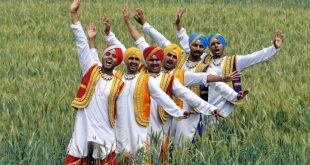
Spring in Punjab means one thing: mustard fields. Acres and acres of brilliant yellow, stretching as far as the eye can see. And that yellow signals the arrival of Baisakhi. For us farmers, it’s the harvest festival, a time to thank the earth for its bounty. Wheat has been reaped; the granaries are full. It’s a time for celebration, for letting loose. I remember the men, my chacha ji included, practicing their bhangra moves in the courtyards weeks before. The women would prepare sarson ka saag and makki di roti, and all sorts of other delights. Our homes would be buzzing.
But Baisakhi is also profoundly significant for Sikhs. It’s the day in 1699 when Guru Gobind Singh Ji established the Khalsa Panth. So, you have this incredible blend of agricultural celebration and spiritual devotion. Gurudwaras across the state become centers of activity. Kirtan fills the air. Langars feed thousands. And the Nagar Kirtans – processions that wind through streets – are a sight to behold. The energy is simply infectious. Drums beat, people dance in the streets, swords are twirled in mock battles. It’s pure spectacle, pure joy.
Growing up in Balachaur, our local Gurudwara would host a huge Baisakhi mela. There would be wrestling matches, kabaddi tournaments, and bhangra competitions that went on for hours. That’s where you’d see the true spirit of Baisakhi festival – raw strength, boundless energy, and an absolute love for life. You don’t just observe Baisakhi; you *feel* it in your bones. It’s a roar of triumph, a celebration of resilience. Most people outside the state just see it as a spring festival, but it’s so much more. It’s a declaration of who we are.
Diwali and Bandi Chhor Divas: Lights, Sweets, and Freedom
Now, let’s talk about Diwali. Everyone knows Diwali, right? The festival of lights. For most of India, it’s Lakshmi Puja, fireworks, and sweets. And yes, we have all that too. Our houses glow with diyas, the smell of fresh mithai fills the air, and for a few nights, the sky is lit up with dazzling displays. But here in Punjab, especially for Sikhs, Diwali carries an extra layer of meaning, a history that many outside the state don’t even know exists. This is our Bandi Chhor Divas.
Bandi Chhor Divas commemorates the day in 1619 when the Sixth Sikh Guru, Guru Hargobind Ji, was released from Gwalior Fort by the Mughal Emperor Jahangir. But he didn’t leave alone. He negotiated for the release of 52 Hindu kings who were also imprisoned there. He famously wore a special robe that allowed the kings to hold onto its fringes, securing their freedom. The return of Guru Hargobind Ji to Amritsar was met with immense joy and the Golden Temple was illuminated with thousands of lamps. Which brings me to what makes this specific celebration so profound for us.
So, while the rest of India celebrates Diwali, we celebrate both. We light our homes for Lakshmi Puja, yes, but our hearts also swell with pride and devotion for Bandi Chhor Divas. The Golden Temple, Harmandir Sahib, in Amritsar, on this night, is an unbelievable sight. It’s not just lit; it’s absolutely drenched in light. Every single surface gleams, reflected in the sarovar, a mirror of pure gold and light. The fireworks over the temple complex are legendary. The Kirtan goes on all night. It’s truly a spiritual spectacle that draws people from all over the world.
I remember my grandfather telling me the story of Guru Hargobind Ji every Diwali. He’d make sure I understood the significance of selflessness and freedom. And honestly, standing there, watching the lights reflect in the water, hearing the sacred hymns, you can feel centuries of history, of faith, of sacrifice. It’s a powerful experience, more than just a regular Punjabi festival. It’s a moment of profound reflection and gratitude. It often coincides with a gurpurab (Gurupurab) like Guru Nanak Dev Ji’s birthday, further amplifying the spiritual energy during that time of year.
The Heartbeat of My Punjab
These aren’t just festivals; they’re the heartbeat of Punjab. They’re the threads that weave our stories, our families, and our communities together. Whether it’s the warmth of a Lohri bonfire, the unbridled joy of Baisakhi, or the luminous devotion of Bandi Chhor Divas, each celebration carries a piece of our history, a taste of our culture.
Moving to the city, I’ve seen these festivals celebrated differently. They’re often more commercial, a bit more toned down. But the core spirit, that deep-seated need to celebrate, to connect, to remember – that’s still there. It’s in the smell of the sweets, the sound of a dhol practicing in a tiny apartment, the excited chatter of children planning their fireworks. It’s proof that no matter where we go, our roots always pull us back.
And that, my friends, is why I write about it. To keep those stories alive. To make sure that the unique charm of our Punjab festivals, the taste of the gachak, the feel of the mustard fields, the stories of courage and faith, don’t get lost in the hustle and bustle of modern life. Because honestly, what’s life without a little bit of dhol, a lot of light, and an endless supply of love?
What’s your favourite festival memory? Share it with me!