 Ek Dum Desi – Your Desi Fitness Tips Buddy Find all desi tried and tested by millions fitness tips here.
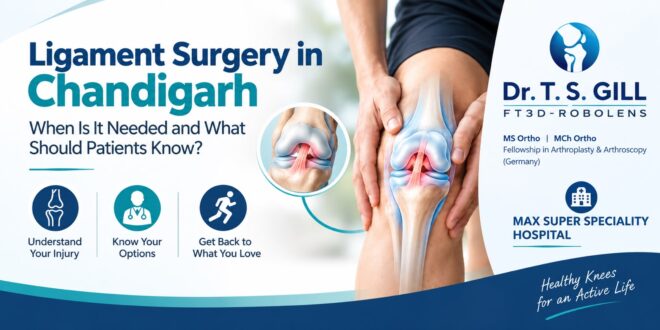
A knee ligament injury can have much more serious consequences than your ability to play sports. Activities of daily living such as walking, climbing stairs, standing for long periods or rising from a chair may be difficult when the knee aches or feels like it is going to give way. These injuries can occur during sports, car accidents, sudden twisting motions or accidental falls.
Some ligament injuries will recover with rest, physiotherapy and correct medical treatment but others may need surgery. Before you can decide on a treatment, you must understand what kind of injury you have, how serious it is and what you need to do.
If you are thinking about ligament surgery Chandigarh, this guide will explain when surgery may be advised, how arthroscopy works, what the recovery involves, and how to prepare for a consultation with an orthopedic specialist.
Knee Ligament Injury: What is it?
Ligaments are strong bands of connective tissue that link bones together and help stabilize joints. The knee contains four major ligaments that assist in controlled movement and stability.
- Anterior cruciate ligament (ACL): Controls the forward motion and rotation of the shin bone.
- Posterior cruciate ligament (PCL) – stops the shin bone from shifting too far backward.
- Medial collateral ligament (MCL): Supports the inner knee.
- Lateral collateral ligament (LCL): Supports the outside of the knee.
- These ligaments may stretch, tear partially or tear completely. Treatment is determined by which ligament is injured, the severity of the injury, associated injuries, and the patient’s activity level.
The usual symptoms are knee pain, swelling, difficulty bending the knee, less confidence when walking and a feeling that the knee may give way. When an ACL injury occurs, you may hear a pop, but it doesn’t mean the ligament is torn.
When does ligament surgery become necessary?
Not all ligament injuries need to be operated on. Many partial tears and some isolated ligament injuries may be managed non-operatively with guide rehabilitation, activity modification and other conservative measures.
However, surgery may be considered if the injury causes persistent instability or significantly limits everyday activities despite appropriate non-surgical care.
1. Complete ACL Tears and Knee Instability
The ACL is often torn during activities that require sudden stops, pivoting or changing direction. A complete tear may lead to repeated episodes of the knee giving way.
ACL reconstruction might be considered for people who want to return to pivoting sports, have ongoing instability, or have associated injuries that impair knee function.
2. Symptoms persisting despite physiotherapy
Physiotherapy can help you strengthen your muscles, improve your balance, movement and joint control. If a suitable rehabilitation program does not make the knee feel stable, an orthopedic surgeon may discuss surgical options.
3. Multiple Ligament Injuries
Knee instability can be severe in injuries involving more than one ligament. Injuries of this type require careful assessment because treatment may involve surgery, staged reconstruction, or a combination of surgical and non-surgical measures.
4. Meniscus or Other Knee Injury Related
Ligament injuries can also occur with meniscus tears, cartilage damage and other structural injuries. The treatment plan should be based on the combined injury, not on the ligament alone.
The ultimate decision should weigh your findings on examination, the results of your imaging, your age, activity goals, general health, and ability to complete postop rehab.
What is arthroscopy and how does it help?
Arthroscopy is a minimally invasive surgical procedure where a surgeon inserts a small camera, called an arthroscope, into a joint to view the inside of the joint. Specialized instruments can be used to deliver therapy during the same procedure.
Arthroscopy can help the surgeon evaluate the joint and perform procedures such as ACL reconstruction or treatment of some associated meniscus injuries for appropriate knee ligament injuries.
During ACL reconstruction, the torn ligament is usually replaced with a graft of tendon tissue. The graft can be taken from the patient’s own body or, in selected cases, from donor tissue. Which option is chosen depends on the clinical situation and the judgment of the surgeon.
If you are a patient looking for arthroscopy Chandigarh, be aware that arthroscopy is a surgical method and not a cure for all knee conditions. Not all ligament injuries are amenable to arthroscopic management and some complex injuries require other surgical techniques.
Your surgeon should tell you about the proposed procedure, the benefits you can expect, the possible risks involved, and the alternatives.
How Is Ligament Surgery Diagnosed and Planned?
A thorough assessment will assist in determining if surgery is indicated and what procedure may be appropriate.
Medical History and Physical Examination
The doctor will ask how the injury happened, when symptoms started, if the knee gives way, and what activities are difficult. Specific tests of examination help to evaluate ligament stability and joint motion.
Imaging Studies
X-ray scans are frequently used to detect fractures or other bone problems. When clinically indicated, an MRI can be helpful in evaluating ligament damage and in identifying injuries to the meniscus, cartilage, or other soft tissues.
Imaging findings are interpreted in conjunction with the physical exam and symptoms. A scan alone doesn’t tell you if there’s a need for surgery.
Individualized Treatment Planning
Your treatment plan should be tailored to your own needs. The treatment goals of a person wanting to get back to competitive football may differ from those of a person whose priority is walking comfortably and being independent in daily life.
An orthopedic consultation will help you decide if you should do rehabilitation, bracing, surgery or a combination of all these.
What to Expect in Recovery for Patients?
Recovery from ligament surgery takes time and requires a structured rehabilitation program. The timeline varies depending on the ligament involved, the surgical procedure, concomitant injuries, and individual progress.
Early rehabilitation
In the early days, your care team will give you instructions about pain relief, controlling swelling, wound care and safe movement. Depending on the procedure and your surgeon’s instructions, he or she may recommend crutches or a knee brace.
Physiotherapy & Strengthening
Physiotherapy is a key component of recovery. Gradually exercises are introduced to restore movement of the knee, develop muscle strength, develop balance and develop joint control.
Follow your prescribed program and do not increase the intensity of the exercise on your own. You may have additional restrictions on movement or weight-bearing if you had a meniscus repair or another procedure besides the ligament reconstruction.
Getting Back to Work, Sports and Daily Activities
Your return to work will be based on the physical demands of your job and the progress of your rehabilitation. Sports that involve jumping, pivoting, or rapid changes in direction generally require a protracted period of time and functional assessment prior to return to participation.
Recovery from ACL reconstruction can take several months, while return to demanding sports can take around a year in some cases. No promise, no date. Your surgeon and physiotherapist should assess your readiness before you return to high-demand activities.
What Are The Potential Risks Of Ligament Surgery?
As with any surgery, there are risks involved with ligament reconstruction. These include infection, bleeding, blood clots, stiffness, ongoing pain, lack of movement and ongoing instability. The reconstructed ligament can be injured again as well.
The risk of complications depends on individual health factors, the injury and the procedure performed.
Before treatment, review your medical history, current medications, recovery expectations, and concerns with your surgeon. If you notice concerning symptoms after surgery, including worsening swelling, fever, wound discharge or significant calf pain, seek prompt medical care. Chest pain or trouble breathing suddenly is an emergency.
Why Choose for Orthopedic Consultation in Chandigarh?
The first step to choosing treatment is a correct diagnosis and clear knowledge of your options. Patients should seek an orthopedic specialist who can explain the injury, discuss surgical and non-surgical approaches, and outline what the rehabilitation requirements are.
Official website of Dr. Tarandeep Singh Gill’s orthopedic practice in Mohali, catering to patients across Chandigarh Tricity. His published profile lists MS Ortho and MCh Ortho qualifications along with fellowship training in arthroplasty and arthroscopy in Germany.
A consultation for patients considering ligament injury treatment can help confirm the diagnosis and decide if specialist rehabilitation, further investigations or surgical assessment are needed.
The objective is not only to perform a surgery but to select a treatment regimen that will treat the injury and allow a safe and realistic return to daily activities.
Frequently Asked Questions
1. Does every ACL tear need surgery?
No. There are people with ACL injuries who can manage their symptoms with physiotherapy, activity modification and rehabilitation. Surgical options can be considered in cases of persistent instability, associated injuries or activity goals that require greater knee stability.
2. How is ligament surgery different from arthroscopy?
Ligament surgery is surgery to repair or reconstruct a torn ligament. Arthroscopy is a minimally invasive procedure that uses a camera and specialized instruments within a joint. Arthroscopy is often used for proper ACL reconstructions, but not all ligament procedures are done this way.
3. How long does it take to recover from ACL surgery?
Recovery is generally several months. For some patients, a return to demanding sports could take around 9-12 months or longer, depending on strength, knee function, rehabilitation progress and clinical assessment.
4. Can a torn ligament heal without surgery?
Some partial tears and selected ligament injuries may improve with non-surgical treatment. With rehabilitation, some patients can still function well, although complete ACL tears are less likely to regain normal ligament structure on their own. The right approach depends on the injury and symptoms.
5. Is arthroscopic ligament surgery for all?
No. Suitability depends on the injured ligament, the nature of the damage, associated injuries and individual medical factors. Your orthopedic surgeon will discuss the correct surgical and non-surgical options.
6. What tests are required prior to ligament surgery?
A physical examination is necessary. X-ray may be needed to evaluate bone injuries and MRI may be recommended to evaluate ligament and other soft tissue injuries. The necessary tests depend on the clinical findings.
7. What are the warning signs of a knee injury that mean you need to see an orthopedic specialist?
Seek an evaluation if you have recurrent knee instability, persistent swelling, difficulty with weight bearing, or symptoms not improving. If you are unable to bear weight, have an obvious deformity, or have severe pain or rapid swelling, get urgent medical evaluation following a major injury.
NAP Details
Doctor: Dr. T. S. Gill
Address: MAX SUPER SPECIALITY HOSPITAL
3RD FLOOR, NEW BLOCK B
PHASE 6, (SECTOR 56)
MOHALI, CHANDIGARH TRICITY
PUNJAB, INDIA
Phone: +91-82880 15106
+91- 62395 89197
Website: https://tsgillortho.com/
Instagram : https://www.instagram.com/drtarandeepsingh
Linkedin: https://www.linkedin.com/in/dr-tarandeep-singh-gill-b88746429/
