Quick answer: A chaupal is the shared meeting place of a Haryanvi village, usually a common building or raised platform with a courtyard, often belonging to the whole gaon or to one patti or thola within it. For generations it was where men gathered over the hukka, where disputes were talked out, where baraats and guests were put up and where news travelled. Mobile phones and changing village life have quietened many chaupals, but the idea of sitting together and talking still runs deep in Haryana.
If you wanted to know anything in our village, you did not ask at home. You went to the chaupal.
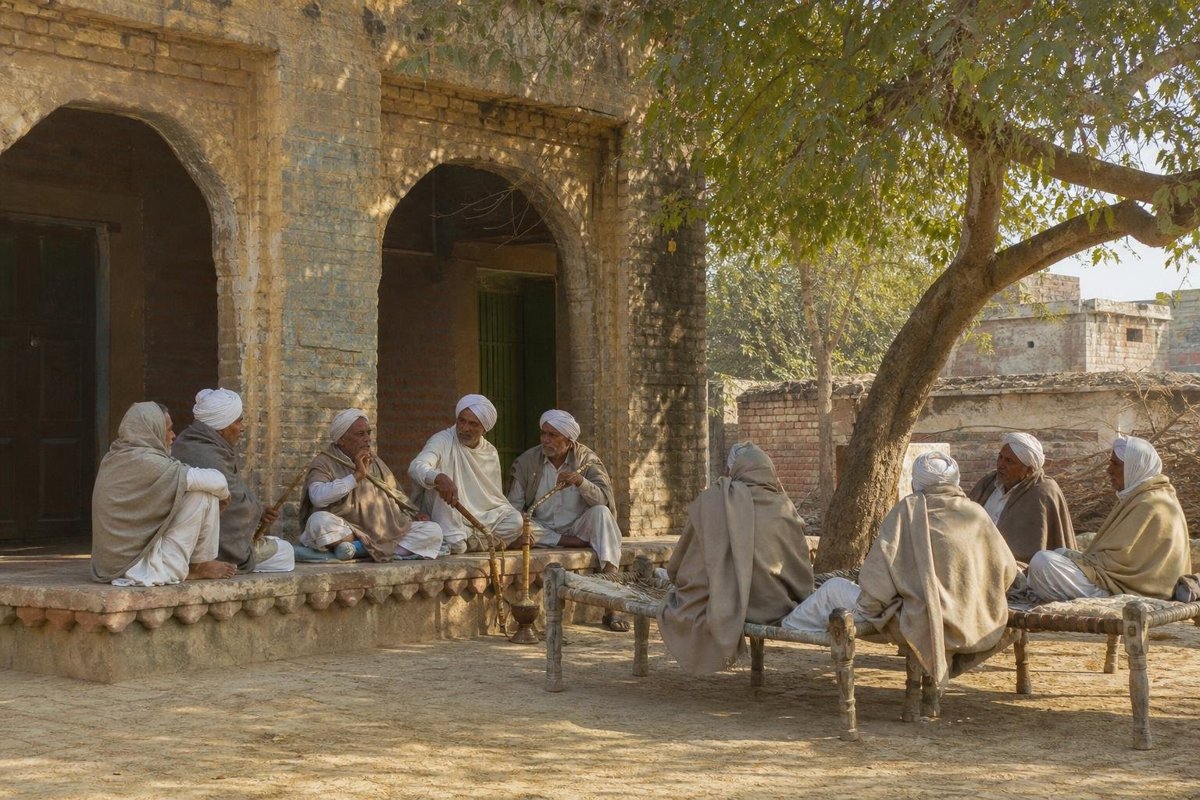
Who had bought a new tractor. Whose daughter’s rishta was fixed. Whether the canal water would come on Tuesday or Thursday. Whether the bus to Rohtak was running after last night’s rain. The answers were all there, sitting on charpais and a long cement chabutra, wrapped in khes blankets, passing a hukka from hand to hand.
I was a child then. I mostly hovered at the edges, sent to deliver a message to my dada or bring back an empty glass. But I remember the sound of it. The gurgle of the hukka. The slow Haryanvi drawl. Sudden loud laughter. Then a long silence while someone thought.
What exactly is a chaupal in Haryana?
Think of it as the village’s drawing room.
Physically, it varied. In older villages, the chaupal could be a solid building with thick walls, arched doorways, a big open courtyard and a raised platform. Some had beautiful old wooden doors and carved jharokhas, built and maintained by the community. In smaller hamlets, it might be no more than a pakka platform under a peepal or a banyan tree.
Larger villages often had more than one, belonging to different pattis or tholas, the sub-divisions of the gaon. Each had its own regulars and its own little politics.
What happened at the chaupal?
Everything that mattered, and a lot that didn’t.
Talk and hukka. In the evenings after the fields, men gathered to smoke, discuss crops, prices, weather and, of course, each other. My dada swore the best weather forecasts in the district came from his chaupal friends, all of whom had been wrong at least once.
Settling matters. Small disputes over a boundary wall or a water channel were often talked through here before anyone went to the thana. Elders listened, argued and tried to find a middle path. It was not perfect justice, and I will come back to that, but it kept many quarrels inside the village.
Hosting guests. When a baraat arrived from another village, the chaupal often became the janwasa, where the groom’s party rested. Visiting relatives, sadhus and travellers might also be given a charpai there for the night. Atithi devo bhava was not a slogan. It was a bed and a glass of milk.
Entertainment. On festival nights, the chaupal turned into a stage. Ragni singers, saang performers and bhajan mandlis drew huge crowds. People sat on rooftops to watch. If you love that side of village life, our story on the folk dances of Haryana, from ghoomar to phag carries the same energy.
Was the chaupal for everyone?
Honestly, no. Not in the old days.
The traditional chaupal was largely a male space. Women in our village had their own gathering spots: the well, the pond, a neighbour’s angan during the afternoon, or the courtyard where they sat together spinning, embroidering and singing. Those spaces had just as much wisdom and far better gossip, if you ask my mother.
Caste lines also shaped who sat where, in many villages. I think it is fair to remember the chaupal with affection while also being honest about who was left outside. Things have been changing, slowly, and in many places women’s groups and gram sabha meetings now use these same buildings.
Why did the chaupals go quiet?
A mix of reasons. Television first, then mobile phones. Families moving to Gurugram, Delhi, Panipat and abroad. Nuclear homes with their own baithaks. Political and family divisions in some villages. And simple economics: old buildings need upkeep, and when nobody owns them personally, repairs get delayed.
When I visited last winter, our chaupal was still standing. The paint was peeling and a few young boys sat on the chabutra, each scrolling his own phone. Nobody was passing a hukka. One old tau ji was there alone, wrapped in his khes, and he seemed very happy when I sat down.
We talked for an hour. About wheat, about my job, about how nobody listens anymore.
Is the chaupal coming back?
In small ways, yes. Some villages have restored their old chaupals as heritage spaces or community halls. Others use them for anganwadi classes, health camps, libraries or panchayat meetings. And the habit of sitting together lives on in winter evenings around a fire or in a neighbour’s baithak, even without the formal building.
The chaupal was never really about bricks. It was about the idea that a village is a shared home, and that talking face to face solves things a phone never will. You can read more about such living customs in our piece on the ancient traditions of Haryana that still live on today, and about the celebrations that once filled these courtyards in the major festivals of Haryana, from Teej to Gugga Navami.
Frequently Asked Questions
What is the difference between a chaupal and a baithak?
A chaupal is a shared, community space for the village or a section of it. A baithak is usually a family’s own sitting room or outer room for receiving male guests.
Who built the chaupals of Haryana?
Most were built and maintained by village communities, often by a particular patti, thola or clan group, using pooled resources. Some were added to or rebuilt over generations.
Do Haryana villages still use chaupals?
Many still do, though less for daily gatherings. They are often used for panchayat meetings, weddings, community events and government programmes.
Is the chaupal only a Haryanvi tradition?
Village meeting spaces exist across north India, in parts of Punjab, Rajasthan and western Uttar Pradesh too, under different names and forms.
Next time you drive past a Haryanvi village, look for the oldest building near the centre with a wide doorway. Stop, say Ram Ram, and see who is sitting there. Then come back and read about the traditional costumes of Haryana, the dhoti, kurta and khandwa those old men still wear.