In short: The Pushkar fair is held every year in the Hindu month of Kartik, usually in November, in the small holy town of Pushkar near Ajmer in Rajasthan. It began as one of the largest camel and livestock fairs in the country and builds up to Kartik Purnima, when pilgrims take a holy dip in Pushkar lake. Go early in the fair for the camel trading and at the end for the religious side.
The first thing you notice is the sound. Not the music, not the crowd. The camels.
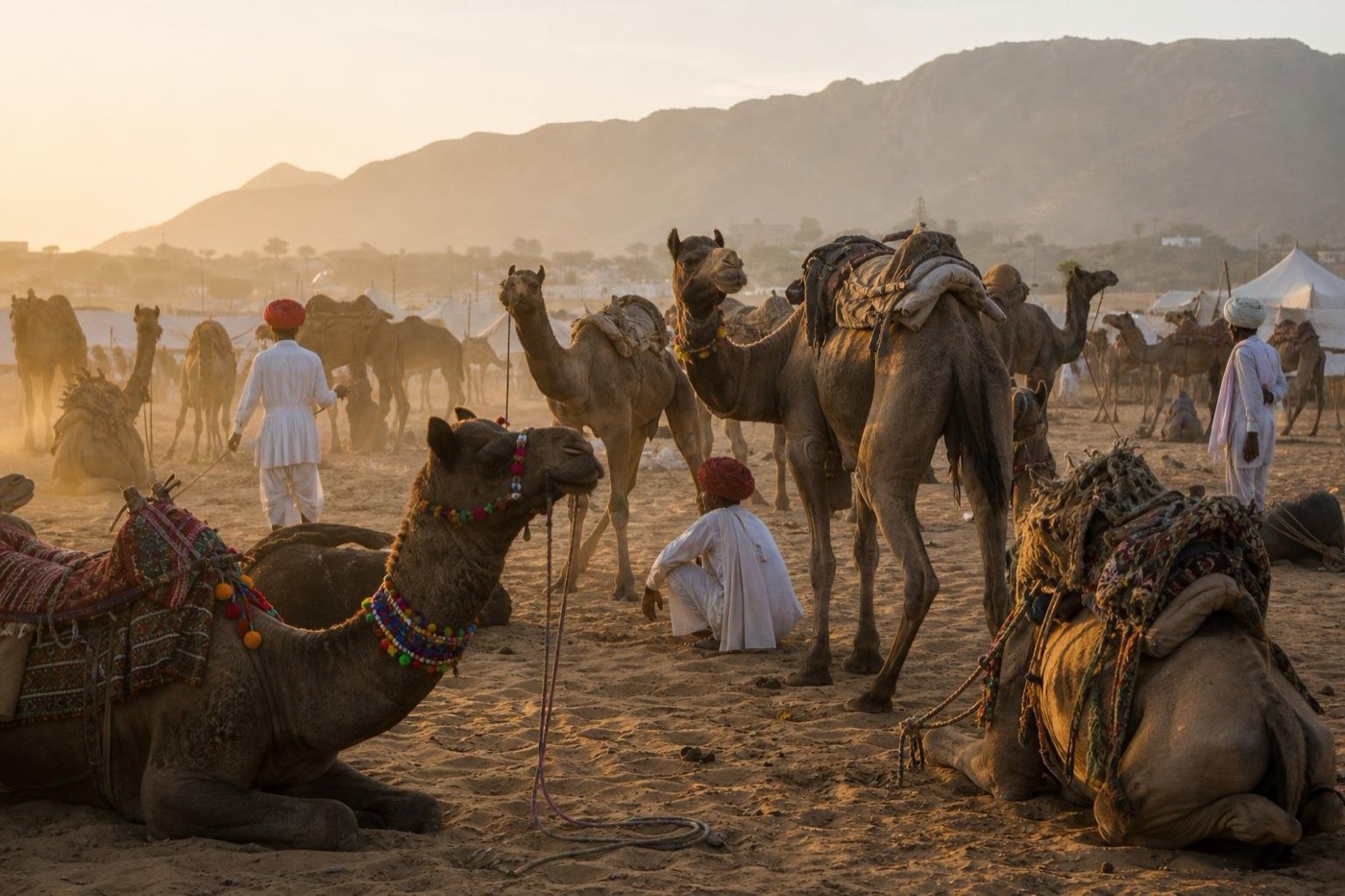
Thousands of them, grumbling and groaning in the half-light before sunrise, their breath steaming in the cold desert air. Herders in white dhotis and bright red pagris walk between them, checking legs and teeth, tightening ropes, arguing quietly over prices that were probably settled before anyone woke up.
My uncle used to drive us from Jaipur to Pushkar every Kartik when we were children. He would wake us at four, bundle us into the back of a Maruti with blankets and a flask of tea, and say only one thing: “Mela bulata hai.” The fair is calling.
What exactly is the Pushkar fair?
The Pushkar Mela, or Kartik Mela, is an annual fair in Pushkar, a small town in Ajmer district, about 15 km from Ajmer city. It has two faces that live side by side.
The first is trade. For generations, herders from across Rajasthan and neighbouring states have brought camels, horses and cattle here to buy and sell. The trading ground on the edge of the dunes fills with animals, tents and cooking fires in the first days.
The second is faith. Pushkar is one of the holiest towns in India, home to one of the very few temples dedicated to Lord Brahma and to a sacred lake surrounded by ghats. The fair builds towards Kartik Purnima, the full moon, when pilgrims gather to bathe in the lake at dawn.
Our overview of Rajasthan’s grand festivals puts Pushkar in context with the Desert Festival and Teej.
When does the Pushkar fair happen?
The fair follows the lunar calendar, so the dates change each year, but it usually falls in late October or November and lasts about a week to ten days, ending on Kartik Purnima. The official dates are published by Rajasthan Tourism every year, and it is worth checking them before you book anything, because hotels fill up quickly.
What should you see at the fair?
- The camel trading ground at sunrise. This is the real Pushkar. Go in the first few days, when most of the trading happens, and go early.
- The ghats at dusk. The evening aarti at the lake, with bells, lamps and chanting, is the calmest hour of the day.
- Brahma temple. Expect a queue during the fair. Photography is not allowed inside.
- The competitions. Over the years the fair has added events such as camel races, decorated-camel contests, matka phod and the famous moustache competition. The line-up changes, so check the programme.
- Folk performers. Kalbelia dancers and Langa and Manganiyar musicians perform around the fair. Read our piece on Rajasthan’s folk dances before you go and you will enjoy them more.
Is the camel trade still important?
Honestly, it is smaller than it used to be. Tractors and trucks have replaced camels on many farms, and herders will tell you that prices and numbers are not what they were in their fathers’ time.
But it has not disappeared. For many Raika and other pastoral families, Pushkar is still the most important week of the year, a place to trade, arrange marriages, meet relatives and catch up on news from a dozen districts. Talk to them respectfully and ask before taking photos. Many will happily tell you about their animals for as long as you want to listen.
What to eat around Pushkar
Pushkar is a vegetarian town, and food stalls around the fair serve dal baati churma, kachori, mirchi bada and endless glasses of masala chai. Malpua from the shops near the main bazaar is something people travel for.
If Rajasthani food is new to you, our list of famous Rajasthani dishes is a good place to start.
Practical tips for visiting
- Book accommodation early. Tented camps are set up during the fair, but good ones sell out.
- Mornings and nights are cold in November. Carry a warm layer and a scarf for the dust.
- Remove your shoes near the ghats and the temple, and avoid leather items in temple areas.
- Alcohol and non-vegetarian food are not permitted in Pushkar town.
- Be wary of anyone offering a “blessing” at the ghats and then asking for a large donation. Politely decline if you are unsure.
- Stay hydrated. The desert sun is strong even in winter.
Frequently Asked Questions
Where is the Pushkar fair held?
In Pushkar, a small town in Ajmer district of Rajasthan, about 15 km from Ajmer and around 150 km from Jaipur.
When is the Pushkar fair?
It is held in the month of Kartik, usually in late October or November, and ends on Kartik Purnima. Check Rajasthan Tourism for each year’s dates.
What is the best day to visit the Pushkar fair?
For camels and trading, go in the first few days. For the religious atmosphere and the holy dip, go closer to Kartik Purnima. Both are worth seeing if you have time.
Why is Pushkar holy?
Pushkar has one of the few temples dedicated to Lord Brahma and a sacred lake believed to be especially holy on Kartik Purnima, when pilgrims bathe at its ghats.
Is the Pushkar fair suitable for families?
Yes, but it is crowded and dusty. Keep children close in the busy areas, carry water and plan a midday break away from the sun.
Before you pack, read about the traditions and customs of Rajasthan so the fair makes even more sense when you get there.