In short: When the first fog settles over the fields in November, Haryanvi kitchens switch to bajra. Bajre ki khichdi with ghee, thick bajra rotis with white makkhan and gur, raab for the throat and churma for the children: these are the dishes that carry a village through winter, and every one of them can be made in a city flat.
Every year, somewhere around the second week of November, my mother calls and asks the same question. “Bajra le aaya?”
It is not really a question. It is a reminder that the season has turned, that the fog will soon sit on the fields outside Rohtak till eleven in the morning, and that a Haryanvi house without a bag of bajra in the corner is not ready for winter.
I grew up thinking every family in India ate this way. It was only after I moved to the city for work that I understood how particular it is. Colleagues from the south had never tasted bajre ki khichdi. Friends from Delhi knew bajra only as “that heavy roti”. So this is my attempt to explain the winter kitchen I grew up in, dish by dish, the way my dadi would have explained it if she had ever been asked.
Why does Haryana turn to bajra every winter?
Bajra, pearl millet, has been grown in the drier parts of Haryana for as long as anyone can remember. It needs little water, it survives the heat that would kill wheat, and it stores well. By the time the kharif harvest is in, the grain is sitting in every kothi.
The older generation will tell you bajra is “garam”, warming. Nutrition science puts it differently: it is rich in fibre, iron and magnesium, it is naturally gluten free and it keeps you full for a long time. Either way, the result is the same. In December, when the cold creeps up from the floor, a bowl of bajra with ghee simply feels right.
We see this pattern across the region. Rajasthan leans on bajra for similar reasons, which you can read about in our story on farming traditions of the desert.
Bajre ki khichdi: the dish that defines the season
This is not the soft rice khichdi people make when they are unwell. Bajre ki khichdi is coarse, nutty and slow.
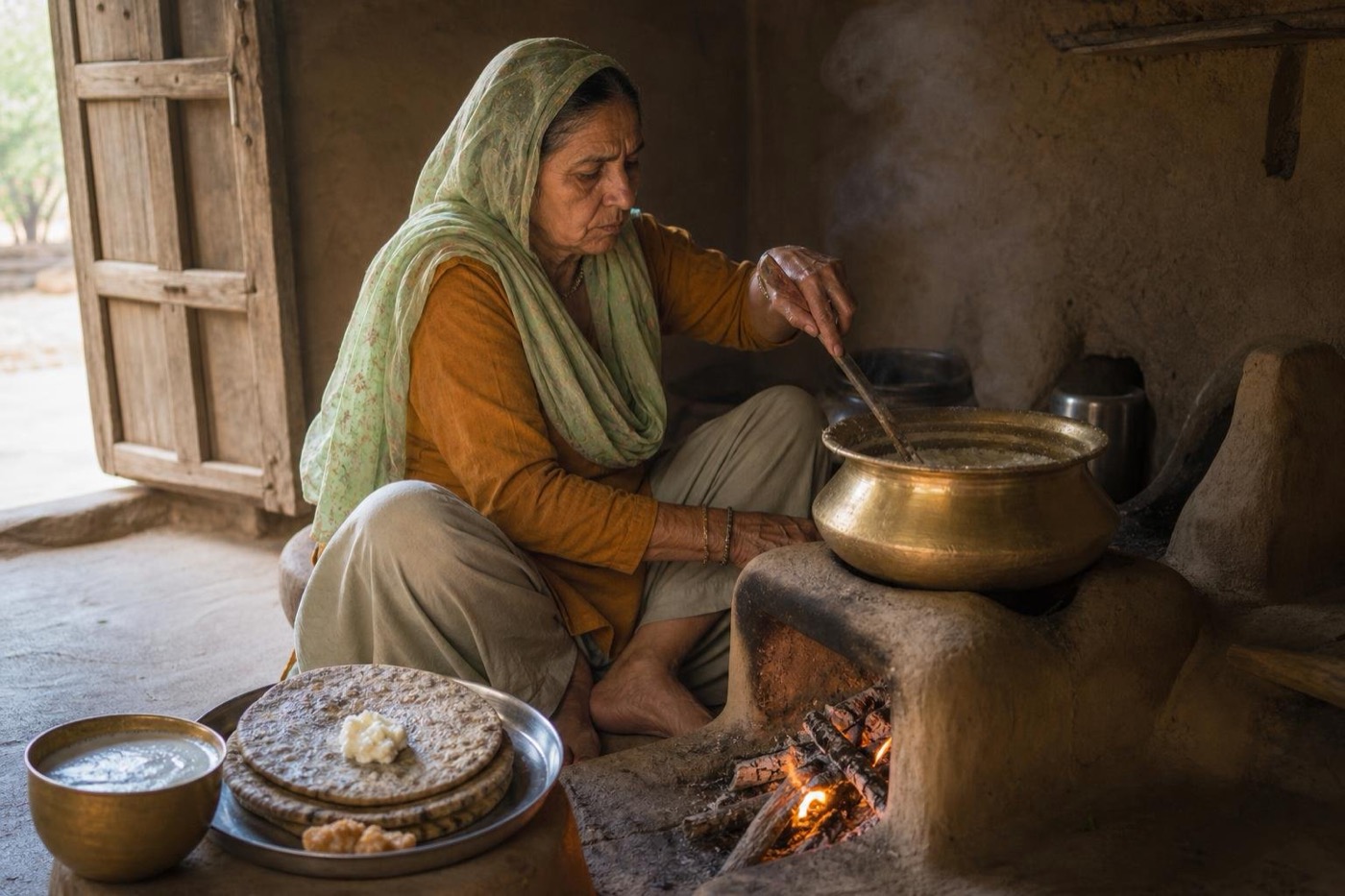
The bajra is soaked overnight, then lightly pounded in an okhli or pulsed in a mixer so the husk loosens. It goes into a heavy pot with split moong dal, water and salt, and then it cooks on a low flame for a long time. My mother still makes it in a brass handi on a chulha when she is in the village, stirring with a long wooden spoon and adding water a little at a time.
It is served with an almost unreasonable amount of desi ghee. Some families pour lassi over it. Others eat it with gur and a spoon of white butter. I have seen arguments break out at weddings over which is correct.
My advice for a first attempt: use a pressure cooker, soak the bajra for at least eight hours, and do not skimp on the ghee. It will taste like the village.
Bajre ki roti with makkhan and gur
Bajra has no gluten, so the dough does not stretch. The roti is pressed out with wet palms, slapped onto the tawa and finished directly over the flame. It cracks at the edges. That is how you know it is right.
The classic plate is simple: two thick rotis, a lump of fresh white makkhan melting on top, a piece of gur on the side and a glass of chaach. Farmers in our village would eat this at sunrise before going out to the fields, and it would keep them going until afternoon.
If you want to see how this sits within the larger Haryanvi plate, our guide to Haryanvi food covers the summer dishes too.
What is raab, and why do grandmothers swear by it?
Raab is a thin, warm drink made by cooking bajra flour in buttermilk or water with a little jaggery and ajwain. It is somewhere between a soup and a porridge.
In our house it appeared the moment anyone coughed. My grandmother would make a pot, pour it into steel glasses and stand there until we finished. Whether it actually cured anything, I cannot say. It certainly made a cold evening feel shorter.
A note of caution, because this matters: raab is comfort food, not medicine. If a cough lasts more than a few days or a child has a fever, see a doctor.
Churma: what happens to leftover rotis
Nothing is wasted in a village kitchen. Leftover bajra or wheat rotis are crumbled by hand, mixed with ghee and powdered gur or shakkar, and sometimes a few chopped dry fruits. That is churma.
Children love it. Grown men pretend they don’t and then finish the bowl. On cold mornings it was packed in a cloth for anyone heading to the fields or the mandi.
How to cook the Haryanvi winter plate in a city kitchen
- Buy whole bajra from a regional grocery or an online store that sells millets, and keep it in an airtight jar. Bajra flour turns bitter quickly, so grind small batches.
- Use a pressure cooker for khichdi. Four to five whistles, then let it sit on the lowest flame for ten minutes.
- For rotis, knead the flour with warm water just before cooking. Bajra dough does not rest well.
- Good ghee and fresh white butter make more difference than any spice.
- Serve with a simple kachri or lehsun chutney if you can find it.
The real secret, though, is time. These are not quick recipes. They belong to long winter evenings, a family sitting close to the chulha, and someone telling the same stories they told last year.
Food is only one part of the season. The festivals that come with it are another, and our piece on the major festivals of Haryana walks through the calendar.
Frequently Asked Questions
Is bajra good to eat in winter?
Bajra is traditionally eaten in the colder months in Haryana and Rajasthan. It is high in fibre and minerals and keeps you full for a long time. People with specific health conditions should check with their doctor before changing their diet.
What is the difference between bajre ki khichdi and normal khichdi?
Normal khichdi is made with rice and dal and is soft. Bajre ki khichdi uses lightly pounded pearl millet with moong dal, cooks much longer and has a coarse, nutty texture.
Why does bajra roti break easily?
Bajra has no gluten, so the dough has nothing to hold it together. Knead with warm water, shape it with wet hands and cook it right away.
What is eaten with bajre ki roti in Haryana?
White makkhan, gur and chaach are the classic pairing. In winter, sarson ka saag and lehsun chutney are common too.
Can bajra be eaten every day?
Many rural families eat it daily through winter. Balance is still sensible, so rotate it with wheat and other grains, and seek medical advice if you have a digestive or thyroid condition.
Next time the fog rolls in, try one dish from this list, then come back and read about the traditions of Haryana that still live on today.