 Ek Dum Desi – Your Desi Fitness Tips Buddy Find all desi tried and tested by millions fitness tips here.
Pain in the hip or knee can limit your ability to do things as simple as walk or climb the stairs. It can make getting up from a chair or returning to your active lifestyle difficult. But knee or hip joint pain can affect more than just movement. With chronic pain in your knee or hip you may need a new solution. Joint replacement surgery may be the answer.
At Chandigarh Orthopaedics and Joint Replacement Institute (COJRI)., you will find specialized care for complex hip and knee problems, revision total joint replacement surgery and robotic knee surgery. COJRI combines unparalleled experience of orthopaedic and joint replacement surgeons with a emphasis on advanced technology and planned rehabilitation.
What Does Robotic Knee Resurfacing Mean?
Within orthopaedic surgery, joint resurfacing or replacement is commonly referred to as robotic knee resurfacing. A surgeon may choose to do a robotic assisted surgery on a patient who may require either partial or total knee replacement if the patient’s condition warrants this treatment.
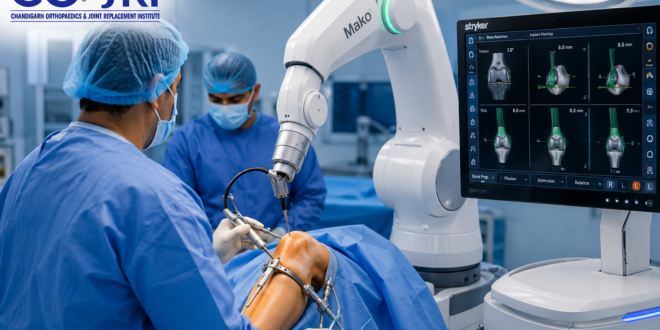
Using advanced surgical imaging and a personalized 3D model, the surgical team can plan and perform bone preparation and placement of the implant with extreme precision. The surgery is performed by the surgeon and the robotic system assists during the surgery.
For those seeking robotic knee resurfacing Chandigarh, you must consider if your case of arthritis, deformity and bone condition is appropriate for robotic assisted surgery.
Considerations for Robotic-Assisted Knee Surgery
Robotic assistance can help with every step of the surgical process for patients who could benefit from total knee replacement. This robotic technology leads to tailored plans for knee replacement surgery.
There are many advantages to robotic assistance including:
- personalized knee surgery plans based on 3D printed knee models,
- assessing the alignment of the knee and preparing the knee adequately with precise placement of the knee implant,
- balancing the knee during surgery, and
- organizing and structuring post-surgery rehabilitation.
COJRI considers their robotic knee program to use Mako technology to help surgeons create personalized 3D models of the knee to help them with surgery.
Even with robotic assistance, surgery is still a complex process, and even with technology, robotic surgery is essentially a tool. An orthopedic surgeon is still required to diagnose and determine the best course of treatment, as well as perform robotic surgery.
Who is a Good Candidate for Robotic Knee Surgery?
The primary indication for robotic knee replacement is severe knee arthritis for which the conservative care methods provide no or little relief. Some of the symptoms include:
- knee pain,
- limited knee range of motion,
- difficulty walking or climbing stairs,
- a noticeable knee deformity,
- advanced knee osteoarthritis,
- an inability to perform normal routine activities of daily living, and
- failure of the conservative treatments.
Robotic surgery is not definitively indicated in all cases. A complete clinical evaluation and appropriate imaging is necessary prior to choosing the appropriate surgical treatment.
What Should You Expect from Treatment?
Your journey starts with a consultation and an assessment of your knee. Your surgeon will take the time to learn about your symptoms, previous treatments, activity level, and your health history. They may also review your imaging.
If robotic assisted surgery is a good treatment option for you, then your surgeon can begin to craft your unique treatment plan.
The overall process typically involves:
- A thorough assessment and treatment plan
- 3D modeling if required
- Removing damaged joint surfaces
- Proper placement of the implant
- Checking the knee for balance and alignment
- Pain control and gradual movement
- Beginning therapy and rehabilitation
The exact process and time required for the recovery will depend on the patient.
Revision Hip Replacement
With a primary hip replacement surgery, people are often able to experience a great reduction in pain and an increase in their ability to function. Unfortunately, over time, a hip replacement can begin to break down due to wear and loosening, infection, instability, or fracture around the implant.
When this occurs, surgery has to once again be considered to alleviate pain and restore function.
Revision Hip Replacement is the term used to describe the surgery that is required to eliminate one or several components of a pre-existing hip replacement surgery and either replace the components that were removed or provide a reconstruction of the area.
Due to the complexities that can occur from scarring, bone loss, damaged neighboring structures from a first surgery, revision surgeries can be much more complicated than a primary hip replacement surgery.
A patient that is considering a Revision Hip Replacement surgeon Chandigarh should do their research and find a surgeon or center that is geared specifically toward Revision and complex joint surgery procedures.
Signs That a Hip Replacement May Need Revision
Not all hip replacements need to be fully replaced after they are done. Symptoms should be investigated if new or bothersome symptoms appear.
Possible symptoms include the following:
- Pain in the new hip
- Spontaenous dislocations of the hip
- Loosening of the implant
- Infection surrounding the hip joint
- Fracture through the implant
- Failure of mechanical components
- Difficulty in walking
- Decreased functioning of the joint following replacement with successful outcome
Depending on the suspected cause, recovery from the surgery may require a physical examination along with X-rays, and perhaps other imaging or lab tests.
Revision Hip Replacement Surgery Requires Specialised Skill
Revision of hip replacement surgery is not the same as primary hip replacement surgery. The surgeon has to manage conditions such as:
- Loss of bone
- Formation of scar tissue
- Changes associated with surgery
- Loosening of the implant
- Infection
- Increased instability
- Fractures around the implant
How the surgeon proceeds with the surgery is dependent on the reason that the first implant failed and the state of the surrounding bone and soft tissues.
Revision of joint replacements for failed or worn-out implants, complex joint reconstruction and the use of specialised implants and protocols for infected joint replacements are the services under the management of COJRI.
Revision Hip Replacement Surgery Recovery
Recovery from revision surgery is known to take longer than typical primary hip replacement surgery.
Rehab is usually made up of the following components:
- Partial or protected weight-bearing when instructed by the doctor.
- Physiotherapy
- Strengthening exercises
- Training to walk with assistance
- Training to aid with mobility
- Monitoring for any complications
- Gradual return to previous routine
Your surgeon and physiotherapists will assess your readiness to increase your activity levels based on the type of surgery, the quality of the surrounding bones, the stability of the implants, and your overall recovery.
Selecting a Joint Replacement Center in Chandigarh
It’s important to understand that every situation is unique. Technology should only be one consideration when determining if Robotic Knee Surgery or an assessment of your previously replaced hip is warranted.
Look for a center that offers:
- Surgeons with Joint Replacement Experience
- Robotic assisted surgery as an option
- Specialization in both complex and revision surgeries
- An individualized approach to care
- Inpatient diagnostics
- Postoperative care and rehabilitation
- Open and honest discussion of the potential risks and benefits of any procedure
COJRI provides the full range of revision hip and knee replacement surgeries along with robotic assisted joint replacement and rehabilitation.
Robotic Knee Surgery and Revision Hip Replacement at COJRI
Chandigarh Orthopaedics and Joint Replacement Institute aims to combine all three of surgical care, modern technologies, and a patient centered focus.
The Institute offers surgical services to include Robotic Knee Surgery, Primary and Revision Knee Replacement Surgeries, Primary and Revision Hip Replacements, Revision Surgeries, Complex Fracture Care, and Rehabilitation.
If knee pain is preventing you from living your normal life, or you have hip replacement pain or instability, come see our orthopaedic surgeons to see if surgery is the right option for you and to determine the best course of action for your particular orthopaedic condition.
Schedule a consultation to address your knee or hip issues and to understand your treatment alternatives with the COJRI team.
Commonly Asked Questions
1. What is the difference between robotic knee resurfacing and knee replacement?
Knee resurfacing done with the assistance of robotics is not necessarily knee replacement. Surface resurfacing is done with either a partial or total knee replacement, depending on how much of the joint has been damaged.
2. Who performs robotic knee surgery?
Surgeons perform the surgery. The robotic system allows surgeons to plan and align tools they use during surgery and provides assistance.
3. What type of patient is a candidate for robotic knee surgery?
Patients in which significant knee pain is present due to stiffness, deformity, arthritis, or limited range of motion. Depending on liming factors, the surgical candidate’s history, exam, and imaging, can determine the surgery.
4. For what reasons may hip replacement revision surgery be necessary?
Hip revision surgery may be recommended for reasons due to an infected, worn, unstable, or previously fractured hip implant with loose components.
5. Is revision hip surgery more challenging than a primary hip surgery?
Very likely. Hip revision surgery may include scar tissue, the need for prior implant removal, and the reconstruction of damaged, lost, or weakened structures.
NAP – COJRI
Business Name: Chandigarh Orthopaedics & Joint Replacement Institute (COJRI)
Primary Centre: Max Hospital, Phase 6, SAS Nagar (Mohali), Punjab
Chandigarh Clinic: Singla Clinics, House No. 3, Sector 19A, Chandigarh – 160019
Panchkula Clinic: House No. 222, Sector 4, Panchkula, Haryana – 134112
Phone: +91 98159 33514 (Dr. Sandeep Gupta)
Phone: +91 84272 70319 (Dr. Jatinder Singla)
Email: info@cojri.com