 Ek Dum Desi – Your Desi Fitness Tips Buddy Find all desi tried and tested by millions fitness tips here.
There is little that can be done to treat knee pain as it affects the quality of life by providing a consistent reminder with every activity from getting around to exercising. Sooner or later, traditional medicine and therapeutic interventions, let alone the help of pain injections, lose their effect and may result in a knee replacement.
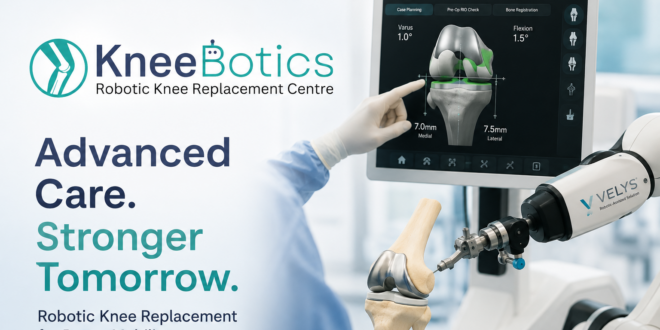
The increasing proliferation of orthopedic technology now includes knee replacement using robotic surgery in Mumbai. These systems help surgeons customize knee replacements based on a three-dimensional model of the knee. This aids the surgeon in preparing the correct cuts and ensures proper orientation and placement of the implants.
Kneebotics, under Dr. Kunal Patel, provides this service using the VELYS Robotic Assisted Solution.
What is Robotic Knee Replacement Surgery?
There is a common misconception about robotic surgery that terms the technology as the independent arm or replacement for the surgeon.
Performing a robotic assisted surgery means the surgeon controls the entire surgery process. Modern technology and many advanced instruments help the surgeon with guidance, navigation of knee anatomy, and execution of precisely the planned operation.
With modern technology, surgery can be planned in 3D and provide the surgeon with real world feedback. NICE referred to this technology as orthopedic surgery performed more precisely as compared to traditional methods.
Patients who want to learn more about robotic knee treatment in Mumbai are attracted to this innovative technology because of the combination of robotic technology and the surgeon’s expertise.
Why Choose Mumbai for Robotic Knee Replacements?
There are many factors that affect health and determine the most appropriate course of treatment for knee replacement. These may include the type, stage, and extent of arthritis, the skeletal alignment, the health of the ligaments, bone density, level of activity, and overall health.
The robotic knee replacement surgery alternative may be the right one, since it allows the surgeon to tailor the surgical plan for the patient’s knee.
Robotic knee replacement may provide the following advantages:
- Customized surgical plans enable the surgeon to prepare and place the knee implants with great precision
- Preservation of healthy tissues
- Improved execution of the surgeon’s plan
- Customized knee replacement procedures based on the patient’s anatomy
- Individualized care and rehabilitation plans
Although the use of robotic technology enables customized knee replacement procedures, it is not always the preferred choice in all patients. The choice of procedure is determined by the evaluation performed by the orthopedic surgeon and the patient’s overall clinical health.
Is Robotic Partial Knee Replacement an Option for You?
A total knee replacement become necessary when all the 3 compartments of knee joint are severely damaged.
When the damage is limited to only one compartment of the knee and the remaining healthy compartments of the knee are actually working well, a partial knee replacement (also known as a unicompartmental knee replacement) may be performed.
A partial replacement resurfaces only the damaged portion of the knee and was originally designed for those patients with disease limited to one knee compartment. However, factors like significant stiffness, ligament problems, and inflammatory arthritis may impact suitability. For this reason, patients seeking Robotic partial knee replacement in Mumbai should be fully aware that the technology should not be the sole criteria for choosing the surgery. A thorough assessment is necessary to determine if partial or total knee replacement is more appropriate.
For the right patient, several important potential benefits may exist when partial knee replacement is chosen instead of total knee replacement.
These include:
- Smaller surgical incision
- Preservation of normal anatomy
- Less disturbance to normal structures
- More rapid recovery
- Possible diminution of post-operative discomfort
- More natural feeling knee for some patients
The American Academy of Orthopaedic Surgeons (AAOS) states that patients who are candidates for partially replaced knees are likely to experience a more rapid recovery, less post-operative discomfort, and less blood loss. The AAOS emphasizes the importance of patient selection.
Partial vs Total Knee Replacement
The choice of partial versus total knee replacement depends on the severity and the pattern of joint damage.
Partial Knee Replacement
A partial knee replacement may be considered when the disease is limited to one knee compartment and the remaining structures of the knee are intact.
Total Knee Replacement
A total knee replacement removes damaged surfaces of the major pieces of the knee joint. It may be used in cases when multiple knee joints are damaged from arthritis.
The NHS states that a partial knee replacement is used in cases when arthritis has only affected a single compartment of the knee, and a total knee replacement is used when a greater extent of joint damage is present.
Your orthopedic surgeon will need to evaluate the severity of your symptoms and X-Rays, perform a physical exam, and take into account any other relevant findings to decide what is the appropriate method to use in your case.
How Robotic-Assisted Knee Replacement Works
Using different techniques and processes, most methods to perform robotic-assisted knee replacement will include a variety of steps.
1. Detailed Knee Examination
The first step includes the surgeon reviewing your knee movement and alignment, joint stability, symptoms, your medical records, and imaging.
2. Tailored Surgical Method
The surgical team uses the available data to prepare for surgery.
Currently, Kneebotics identifies the VELYS Robotic-Assisted Solution and describes the process to be personalized support for the surgeon throughout the entire process including surgery and post-surgical recovery.
3. Assistance Through Surgery
During the surgery, the robotic system is used to assist the surgeon during the planned surgery.
The robot assist system does not perform the surgery. The surgeon makes all clinical decisions and will control the entire process.
4. Placement of the Implant
The positioning of the implant during knee replacement surgery is important, and medical robotic assistance provides additional information to the surgeon to help optimize implant placement.
Recovery from surgery encompasses many aspects. These include but are not limited to, physiotherapy, exercises, wound management, medications, follow-up appointments, and gradually returning to normal levels of activity.
Who is a Candidate for a Robotic Knee Replacement?
Patients who may be candidates for a robotic-assisted knee replacement may have the following concerns:
- Severe osteoarthritis
- Daily activity limiting knee pain
- Reduced mobility
- Deformed knee due to arthritis
- Arthritis that is more localized and may be treated with a partial knee replacement
- Knee injury that has not improved with other treatment methods
Knee replacement surgery is performed when the knee pain and stiffness affects daily living and non-surgical treatments have not helped.
It is important to note that robotic surgery is not a substitute for regular surgery. The focus is always on whether knee replacement is right for the patient, and what surgical methods align best with the patient.
What sets Kneebotics apart?
Kneebotics is a company that focuses on the specialist field of robotic surgery of the joints specifically within the field of orthopedic surgery.
Dr. Kunal Patel is described on the website as a consultant orthopedic surgeon and specialist in the field of robotic knee surgery. The website also provides information on the VELYS Robotic-Assisted Solution and the ATTUNE Knee System that are a part of the personalized knee replacement service.
When selecting a center for robotic knee treatment, patients need to understand the following:
- Years of experience in orthopedics of the surgeons at the center
- How many times the surgeons have used robotic aids
- The type of technology that the center uses
- If the surgeons review the patient’s file personally
- What type of hospital and surgical facilities does the center have
- How the patient’s knee will be rehabilitated and the type of follow-up that the center offers
- If the patient is an apt candidate for robotic surgery
Post-Robotic Knee Replacement Surgery
No two patients’ recoveries are the same. Age, health, knee strength, arthritis severity, type of knee replacement, and compliance with rehabilitation will all impact your recovery.
Many patients will need to start post-operative physical therapy and start mobilization early on. The goal of the physical therapy is to regain:
- Movement in the knee
- The strength of the muscles
- Balance and the ability to walk
- Independence
You cannot compare your recovery to that of any other patient, as your orthopedic team will provide a personalized activity and rehabilitation plan.
Is Robotic Knee Surgery The Way To Go?
Robotic aids help surgeons through the planning process and provide extra navigation assistance, but they do not guarantee better outcomes for each patient.
Factors such as surgery planning, appropriate patient selection, surgical experience, the type of implant used, rehabilitation, and the patient’s overall health impact the success of knee replacement.
The correct line of questioning is not whether robotic surgery is “better.” It is if robotic-assisted surgery is appropriate for your knee, and if it will help your surgery.
When should you see a knee replacement specialist?
If you have knee pain that:
- Causes problems while walking
- Impacts your sleep
- Impact stair navigation
- Limits how much exercise you can do, or impacts your daily activities
- Going stiff
- Isn’t improved by precautionary measures
- Is accompanied by swelling or deformities that impact range of motion
A consultation does not guarantee surgery, but it helps to understand the cause of the pain to come up with a treatment plan.
Choosing Robotic Surgery in Mumbai
If you are looking into robotic surgery in Mumbai, focus on the treatment pathway over the technology.
Here are some examples of questions you can ask your surgeon:
- What is causing my knee pain?
- Am I a candidate for knee replacement?
- Am I a candidate for a partial knee replacement?
- Will partial or total knee replacement be required?
- What robotic-assisted aids will be used for this surgery?
- What are the anticipated benefits and drawbacks?
- What will my recuperation entail?
- What should I understand about the risks of surgery?
A personalized consultation will help you make an informed decision about your knee based on your individual case and not just the information available to you online.
Conclusion
Using robotic technology in orthopedic surgeries, especially knee replacements, is the next frontier of surgery. It not only assists surgeons in planning and executing a surgery but also positions implants in a precise manner.
For those interested in Robotic partial knee replacement in Mumbai, the first consideration is if the arthritis is limited enough to warrant a partial knee replacement. For more extensive arthritis, a total knee replacement may be more appropriate.
If persistent knee pain limits your quality of life, schedule an appointment with a specialist to learn more about your options and the potential benefits of robotic-assisted knee replacement.
Frequently Asked Questions About Robotic Surgery in Mumbai
1. What is robotic surgery in Mumbai for knee replacement?
Robotic-assisted knee replacement surgery uses modern digital and robotic systems to assist surgeons in planning, guiding, and executing procedures. The surgeon retains control of the surgery.
2. Is robotic knee replacement safe?
Robotic-assisted technology has become commonplace in orthopedic surgeries. That said, every surgical procedure has some associated risks, and the best orthopedic surgeons determine the appropriate course of action.
- What is Robotic partial knee replacement in Mumbai?
Robotic partial knee replacement is a surgical option where only the damaged knee compartment is replaced. This is possible if arthritic changes are only present in one compartment of the knee and the rest of the knee is healthy.
- Is robotic surgery better than conventional knee replacement?
Robotic systems offer digital, real time inputs, navigation systems, and tools that provide feedback during surgery. However, in such a scenario the best approach to surgery is contingent on the patient’s needs, the surgeon’s discretion, and available technologies. Use of robotic systems does not guarantee a better outcome in all patients.
- How long does it take to recover from robotic knee replacement?
Recovery post knee replacement surgery is influenced by the type of replacement and a patient’s general health. Most patients begin moving around with the help of a walker/crutch, and post this begin a series of exercises to facilitate a return to normal function. Each patient is advised a rehabilitation schedule based on the opinions of the surgeon and physical therapist.
- Who is a candidate for partial knee replacement?
Patients with arthritic changes restricted to one knee compartment are candidates for partial knee replacement surgery, provided other knee compartments remain healthy, knee ligaments remain intact, and a patient has an adequate range of motion.
- Does robotic knee surgery require a CT scan?
In general, this is not needed. The specific requirement for imaging is based on the robotic system and the surgical protocol in use. Kneebotics has stated that in the VELYS knee system, there is no need for special CT scans or MRIs that are done for the robotic system.
- What is the right way to choose a robotic knee surgeon in Mumbai?
Picking a robotic knee surgeon requires skill. Focus on an orthopedic surgeon who has performed many knee replacement surgeries as well as surgery assisted by robotic procedures. Discuss your diagnosis, surgery options, the technology involved, and the anticipated pros and cons, as well as the rehabilitation and follow up care before making a decision.
NAP – Kneebotics
Business Name: Kneebotics – Robotic Joint Replacement Center
Address: Plot No. 3, S. V. Road, Punit Nagar, Borivali West, Mumbai, Maharashtra 400092, India
Phone: +91 93727 37914
Email: drkunalpatel@gmail.com
Website: https://kneebotics.com/
For appointments, Kneebotics currently lists +91 93727 37914 and the Borivali West, Mumbai address on its contact page.
Connect With Kneebotics
Facebook: https://www.facebook.com/KneeBotics
Instagram: https://www.instagram.com/kneebotics/