If you live in Mumbai, you already know what your knees go through. Local train platforms, steep staircases in older buildings, long walks to the station in monsoon, sitting cross-legged during pujas and family gatherings. When one part of the knee wears out, all of this starts to hurt, and many people quietly adjust their lives around the pain for years before they ask for help.
If that sounds familiar, there is a good chance someone has mentioned robotic surgery in Mumbai to you, or you have come across the phrase robotic partial knee replacement in Mumbai while searching late at night. This blog explains, in plain language, what that surgery is, who it is meant for, and what you should ask before deciding.
First, a quick look at knee arthritis
Your knee has three compartments: the inner (medial) side, the outer (lateral) side, and the front, behind the kneecap. Osteoarthritis does not always wear out all three at once. In a good number of people, especially in the early to middle stages, the damage is mostly on one side, usually the inner side.
This matters because it decides what kind of surgery makes sense. If the whole knee is badly worn, a total knee replacement is usually the answer. If only one compartment is damaged and the rest of the knee is healthy, a partial knee replacement may be an option.
What is a partial knee replacement?
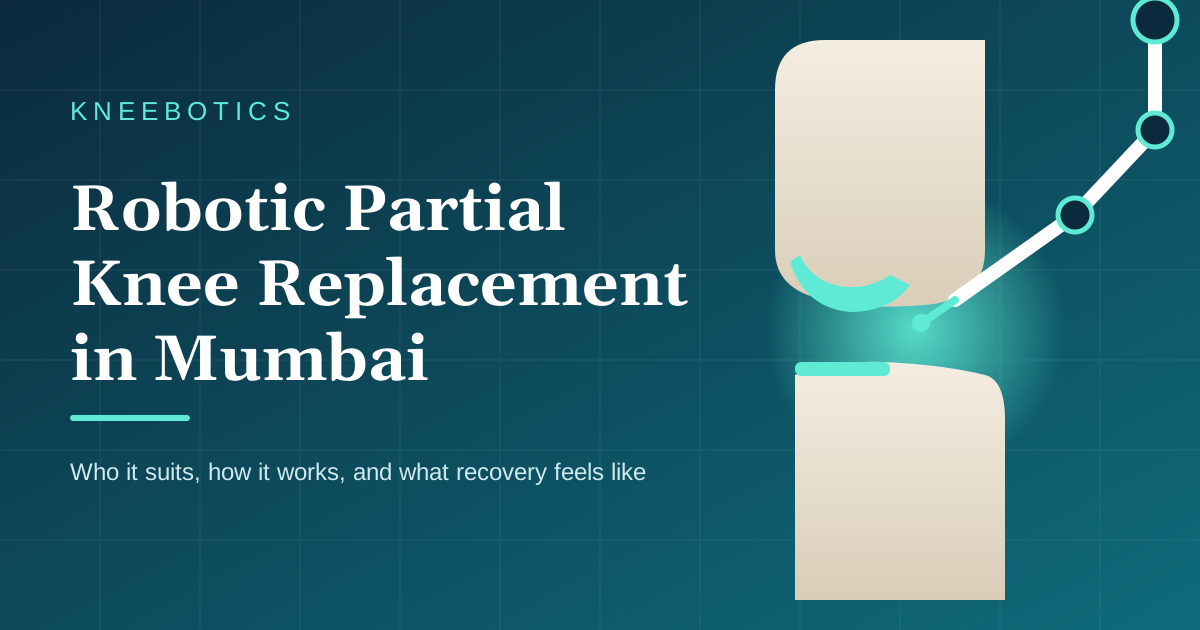
In a partial knee replacement, the surgeon resurfaces only the damaged compartment of the knee with a metal and plastic implant. The healthy bone, cartilage and ligaments in the other compartments stay where they are. Because less of the natural knee is removed, many patients say the knee feels more like their own afterwards.
It is not a smaller version of a bad idea. It is a different operation for a different pattern of arthritis, and it only works well when the patient is chosen carefully.
Where the robot comes in
The word “robotic” makes people nervous, so let us be clear: the robot does not operate on its own. The surgeon is in control throughout. The robotic system is a tool that helps the surgeon plan and carry out the operation with greater precision.
In a typical robotic partial knee replacement, the process looks like this:
- Planning: A CT scan or the system’s own mapping builds a 3D picture of your knee, so the plan is based on your anatomy and not an average one.
- Preparation of bone: During surgery, the robotic arm keeps the surgeon’s instruments inside the boundaries that were planned, so only the diseased bone is removed.
- Alignment and balance: The implant is positioned and the soft tissues are balanced with real-time feedback, which matters a lot in a partial replacement where the margin for error is small.
The aim is simple. Better placement of the implant, less unnecessary bone removal, and a knee that moves the way it should.
Why people look for robotic surgery in Mumbai
Mumbai has a large number of hospitals and surgeons, which is good, but it also makes choosing harder. People usually search for robotic knee surgery here for a few practical reasons:
- They want a procedure that treats only what is damaged and keeps the rest of the knee.
- They want to get back to normal life, work and walking sooner.
- They want a surgeon who has experience with the specific system and the specific procedure, not only with joint replacement in general.
- They want to stay close to family and a trusted hospital instead of travelling far for treatment.
These are sensible things to care about.
Who may be a good candidate?
Robotic partial knee replacement in Mumbai is not for everyone, and an honest surgeon will tell you that. It is more likely to be considered if:
- Your arthritis is mostly in one compartment of the knee
- Your knee ligaments are in good condition
- Your knee still has a reasonable range of movement and is not severely deformed
- Pain is affecting daily life despite medicines, physiotherapy, weight management or injections
It is usually not suitable when arthritis has spread through the whole knee, or when there is significant stiffness or deformity. That decision is made after a proper clinical examination and X-rays or MRI, not from a website. Treat this section as a guide to the conversation, not a diagnosis.
What recovery usually looks like
Every person heals differently, so please take timelines as general guidance and not a promise.
Most people are encouraged to start moving early, often within a day of surgery, with the support of a physiotherapist. Walking with a walker or sticks at first is common. Swelling and stiffness in the first few weeks are normal. Physiotherapy is a big part of the result, and the exercises you do at home matter as much as the operation itself.
Many patients find that recovery after a partial replacement feels quicker than after a total replacement, partly because less of the knee has been disturbed. Still, how well you follow your rehab plan, your age, your general health and your starting fitness all play a role.
Questions worth asking your surgeon
Before booking any surgery, it helps to go in with questions. Here are some good ones:
- Is my knee actually suitable for a partial replacement, or would a total replacement serve me better?
- How many robotic partial knee replacements do you perform in a year?
- Which robotic system do you use, and why?
- What are the risks specific to my case?
- What will my first two weeks look like, and when can I climb stairs, drive or return to work?
- What happens if the partial replacement needs to be revised in future?
A good surgeon will welcome these questions. If you feel rushed or brushed off, that tells you something too.
Is it worth considering early?
A lot of people wait because they are afraid of surgery, or because they have been told to “manage” the pain. Waiting is sometimes the right call. But in some cases, arthritis that stays limited to one compartment for a while can spread, and the option of a partial replacement may be lost. If your knee pain is limiting you and treatments are no longer helping, a consultation is a low-risk first step. You are not committing to anything by asking.
Frequently asked questions
Is robotic surgery in Mumbai safe? All surgery carries risk, including infection, blood clots and stiffness. Robotic assistance is designed to improve precision, but safety depends on patient selection, surgeon experience and good post-operative care. Your surgeon should explain risks clearly.
Does the robot perform the surgery? No. The surgeon plans and performs the operation. The robotic system assists with accuracy.
How long does robotic partial knee replacement take? The surgery commonly takes around one to two hours, though this varies. Your hospital stay is usually short, and your surgeon will give you an estimate for your case.
Will I be able to sit cross-legged or climb stairs afterwards? Many patients regain good function and bending, but cross-legged sitting depends on the individual knee. Ask your surgeon what to realistically expect.
How do I know if I need a partial or total knee replacement? Only an examination and imaging can answer this. That is why a proper consultation comes first.
Final thoughts
Robotic partial knee replacement in Mumbai is a thoughtful option for the right patient: someone whose arthritis is confined to one part of the knee and who wants to keep as much of their natural knee as possible. It is not a magic fix, and it is not for everyone. What matters most is an accurate diagnosis, an experienced surgeon and a rehab plan you can stick to.
If knee pain is slowing you down, book a consultation to find out whether robotic surgery is right for you. Visit Kneebotics to learn more or to get in touch.
NAP – Kneebotics
Business Name: Kneebotics – Robotic Joint Replacement Center
Address: Plot No. 3, S V Road, Punit Nagar, Borivali West, Mumbai, Maharashtra 400092
Phone: +91 93727 37914
Email: drkunalpatel@gmail.com
The address and appointment details are listed on the official Kneebotics contact page.
Follow Kneebotics on Social Media
- Facebook: https://www.facebook.com/KneeBotics
- Instagram: https://www.instagram.com/kneebotics/