Quick answer: A trinjan was a gathering of Punjabi girls and women who sat together with their charkhas, spinning cotton through winter afternoons and evenings while singing folk songs. It was work, friendship and a private space to speak about love, longing and life after marriage. The circles have mostly faded, but their songs still live on in giddha, weddings and our mothers’ memories.
My nani had a charkha that nobody was allowed to touch.
It sat in the corner of her kotha in a village near Bathinda, wrapped in an old phulkari dupatta, and every winter when we visited she would pull it out, oil the wheel with a drop of sarson ka tel and start spinning. The sound was soft, a kind of ghoon ghoon that made you sleepy. And then, almost without fail, she would start humming. Once I asked her where she learnt those songs. She laughed and said one word: “Trinjan.”
That word stayed with me for years before I understood what she meant.
What exactly was a trinjan?
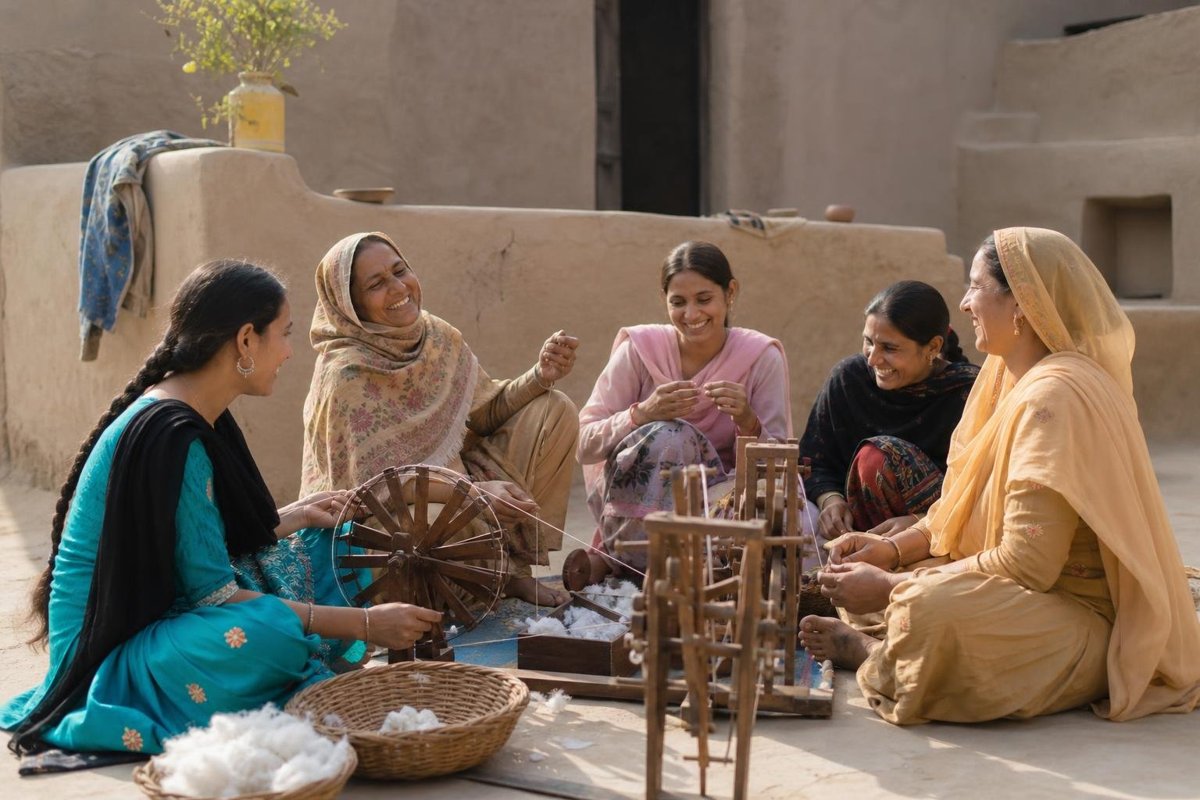
In rural Punjab, a trinjan (some families say tranjan) was a group of girls and young women from the same mohalla or village who gathered to spin together. Someone’s courtyard or a wide roof would become the meeting place. Each girl brought her own charkha, her own pooni of carded cotton, and they would sit in a loose circle and spin for hours.
The season mattered. Once the cotton had been picked and the cold had settled in, the fields needed fewer hands. That is when the charkhas came out, with a lot of yarn to make for durries, khes and the dowry chest.
But calling it just a spinning session is like calling a wedding a lunch.
Why did the songs matter so much?
Here is what I find beautiful. The trinjan was one of the few places where young women could speak freely, away from elders and men. And they did it through song. Spinning is repetitive, the wheel keeps a rhythm, and the songs naturally fell into that rhythm.
From what my nani and her sisters told us, and from the folk collections I have read since, the songs covered everything. A girl missing her mother after being married into a far village. Teasing about a future husband. Complaints about a strict saas, sung half as a joke. Prayers for a brother away in the army. The longing of a woman whose husband had gone to the city or across the seas for work.
The charkha itself appears again and again in Punjabi folk poetry. It becomes a stand in for the woman’s own heart, turning and turning, waiting.
We see this pattern across north Indian folk culture. Work songs carried feelings that could not be said directly. In Haryana, women had their own winter gatherings and songs too, and you can read a little about that world in our piece on ancient traditions of Haryana that still live on.
How did a trinjan actually work?
There was no written rulebook, obviously. But a few customs come up in almost every account I have heard.
Girls of roughly the same age spun together, and an older woman might sit nearby to keep an eye. There was often friendly competition. Who spun the finest thread, who finished her pooni first. My nani remembered a few nights near the end of the season when the girls stayed up spinning much later than usual, racing to finish. Customs like this differed from village to village, so I would not claim it was the same everywhere.
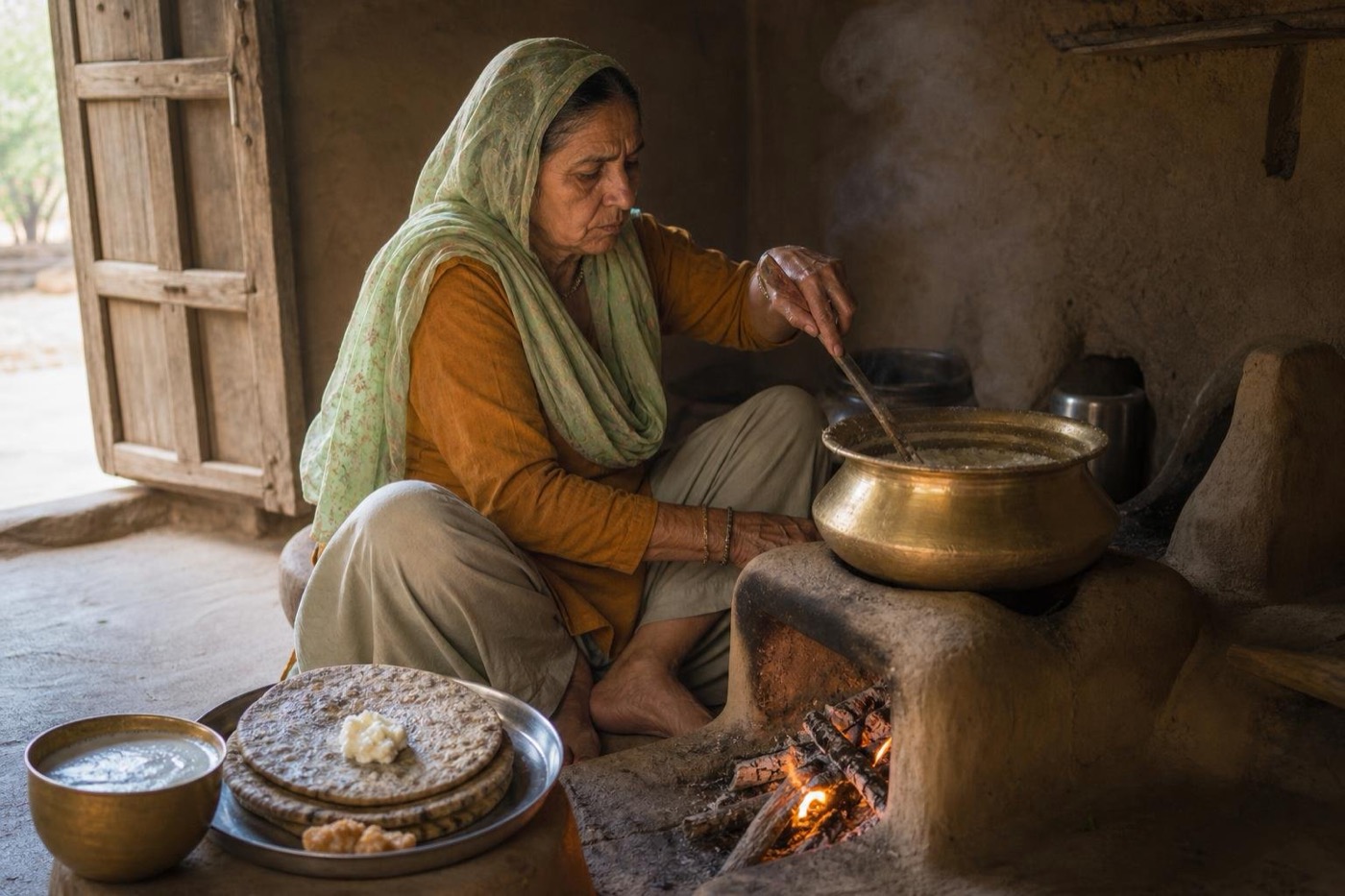
Snacks were simple. Roasted chane, gur, maybe some til ki pinni if someone’s mother was generous.
And when a girl got married and left for her sasural, her trinjan friends sang her off. That bond was real. My nani used to say her trinjan sahelis knew her better than her own sisters did.
What was spun, and where did it go?
The yarn went into the most practical things in a Punjabi home. Thread for weaving khes, the thick cotton sheets every bed had. Durries for the floor and for guests. Base cloth for embroidery. A bride’s trunk was judged, a little unfairly, by how much she and her family had made.
The link with phulkari is strong. The khaddar cloth that women embroidered with silk floss often started its life as handspun yarn. If you love that craft, our story on folk art and crafts of Punjab covers phulkari, woodwork and pottery in more detail.
Why did the trinjan disappear?
Mill cloth. Electricity. Television. Schools for girls, which is a good thing, let’s be clear. Once ready made fabric became cheap and easy to buy in the nearest mandi town, there was little reason to spend a whole winter spinning. The charkhas went up to the parchhatti, the storage shelf, and slowly to the kabadiwala.
Families also changed. Girls studied, worked, moved to Ludhiana, Chandigarh, Delhi, Canada. My own cousins grew up in the same village where nani spun, and not one of them has ever sat at a charkha.
I am not going to pretend that this is all loss. Many of those winters were also long and hard, and women carried a heavy load. But the songs, the sisterhood, that specific way of sharing a feeling through a tune? That is worth remembering.
Where do the trinjan songs live today?
Surprisingly, in many places. Giddha, the women’s dance of Punjab, carries boliyan that feel like trinjan songs set to claps. Wedding nights still have women singing teasing songs and sad farewell songs. Some folk singers have recorded charkha songs, and you will hear them at cultural melas and university youth festivals.
Read our piece on the folk dances of Punjab, including giddha and you will notice the same spirit. Women in a circle, one voice starting, the rest answering.
Frequently Asked Questions
What does the word trinjan mean?
It refers to a group of girls or women who gathered to spin cotton on charkhas together, and also to the gathering itself. Spellings vary, such as trinjan and tranjan.
In which season did trinjan gatherings happen?
Mostly in the winter months after the cotton was picked, when farm work slowed down and days were short. Evenings and sunny afternoons were the usual times.
What kind of songs were sung in a trinjan?
Folk songs about missing the maika, marriage, teasing, love, separation and family life. Many used the charkha as an image for a woman’s own feelings.
Is the trinjan tradition still alive?
Not as a regular village practice in most places. The songs survive through giddha, wedding singing, folk recordings and cultural festivals, and some families revive it informally.
Was the trinjan only in Punjab?
The name is Punjabi, but women’s spinning and singing gatherings existed in many parts of north India, including Haryana, under different names and customs.
If this made you miss the old winters, you might enjoy our story on the rich traditions of Punjab, from Lohri to Baisakhi, which my nani would have loved too.